Here is a very neat idea that I had not seen before: combine an event camera with an electrically controlled liquid lens. The paper Active Neuromorphic Space Imaging and Focusing using Liquid Lenses describes driving the lens rapidly through a range of optical powers. Each oscillation passes through the best-focus region and creates changes that trigger the event sensor. The authors report improved source detection, sensitivity, noise filtering and localisation, as well as a way to focus an event camera rapidly on astronomical fields.
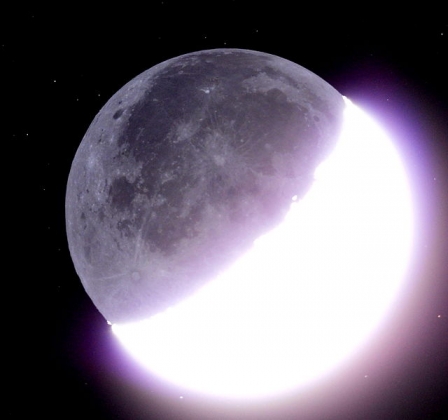
The attractive number is the quoted dynamic range of about 140 dB. Using the familiar approximation of 6.02 dB per bit, that is about 23 bits. This number describes the illumination range over which the sensor can respond; the bit depth and photometric quality of a reconstructed image are separate questions. Our 100-image Mauna Loa stacks reach roughly 110 dB, or about 18–19 equivalent bits. On the best nights they only just reveal the halo outside the dark side of the lunar disc. Better characterisation and modelling of that halo will require more information over a wider intensity range.
For Earthshine observations, we might drive the liquid lens repeatedly back and forth across the focus point, record the event stream together with the lens-control signal, and accumulate or reconstruct the data produced near peak focus. The changing focus supplies the variation needed by a sensor that responds to changes in intensity. This connects directly with the question raised in the earlier post on the DAVIS neuromorphic camera.
There are plenty of possible problems. The event stream must be converted into a calibrated image. Focus changes alter the point-spread function and may also alter image scale. Event thresholds, noise, lens hysteresis, temperature sensitivity and synchronisation with the lens drive will matter. Light scattered from the bright lunar crescent remains an optical limitation. A suitable liquid lens must also have adequate aperture and wavefront quality, and it must work in a telescope that tilts through a large range of elevations.
The cheapest event camera I have seen costs about 600 euros and looks mechanically rather modest, although prices are falling. The liquid lens is also interesting. I currently have no idea how to make a useful one, or how to mount and control one reliably in a tilting telescope. This seems worth following as both technologies develop.

